But maybe tea isn't the unqualified ballroom gala I think it is. Is tea an institutionalized locus of formality, tradition and manners? Yes, for now, but as the practice of tea drinking grows out of its box of history and spills its tendrils out into the wider world of public consumption, touching different demographics, ages, nationalities and occasions, these new brews will come to be accepted as full fledged members of the tea club.
For today's review, and by eccentric brew, I am referring to Aroma Tea Shop's Milk Aroma Oolong. The full retreat from tea tradition is pretty obvious in the "Milk" part, and I don't think it is unwarranted. Milk pairs with a lot of foods to produce a delicious cooperative of flavors - milk and cookies, milk chocolate, malted milk balls, but tea? Milk tea? But wait! Do we not put milk with our black teas to produce a creamy, easy to drink blend? Why yes, we do - but check out the word that comes after "Milk": Oolong. I'd no sooner add milk to an Oolong than I would a green tea, or milk to a martini. It doesn't work, and not even the trampling, barbarian and uncouth hordes of American consumers have dared to revise green tea or oolong to suit the sugary, creamy and high-fat American diet which has stirred up a flurry of fat conscious journalism.
So what does it mean to be a Milk Oolong? Taken from Aroma Tea Shop's page -
"Being featured in Lucky Magazine, this top selling tea is taking the nation by storm! We were drowned in orders nationwide, having orders coming from New York, Dallas, and across to San Diego. This tea actually originated from Taiwan, where they took the tea leaves and steamed them with milk. After the steaming process, the tea is then oxidized under the sun. The result is the amazing taste that this tea produces. It's sweet, creamy, and so smooth. Don't miss out on this one!"
Milk Oolong, then, is a run-away popular drink with mass appeal, a light dose of hot dairy and the standard oxidation step. Sounds appealing, but I still feel like there's more information to be had. Where did it come from, who developed it and is it edging out other teas in the tea market?
Next I made a visit to TeaChat where the amateur brain trust of tea gathers in its mysterious, nightly consortiums to dictate the whims and whiles of the tea industry. I found clearer answers there.
To summarize, a proper Milk (alternatively called Silk) Oolong is produced when the growing tea leaves undergo swift, dramatic changes in weather conditions, especially sudden frosts. However, this seems to clash with Aroma Tea Shop's description, so I'm going to guess there are two methods. One is au naturale, while the other is artificial, probably in effort to lower costs and offer a respectable replacement. Until I try a "real" Milk Oolong then, I'll take my cues from Aroma Tea Shop's milk sprayed version, which, even if spliced together in a lab, still tastes pretty darn good.
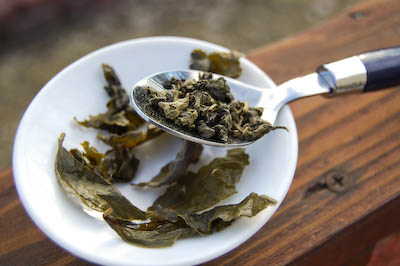
Leaf & Liquor: The moss and olive green knotted furls of tea, like the facial protrutions of Peter Jackson's Ents in his cinematic version of the Lord of the Rings, look aged and creased, in tune with nature, like nuggets of forested essence. They are something one might find in a Miyazaki Hayao film, pulsing with a deep teal glow beneath a pile of shaded leaves, serendipitously discovered by a mistreated youth. That's saying quite a lot, just for a balled up leaf. Though serious in their appearance, the leaves belie something far more playful - Milk flavor. Unfurled these leaves show up in a range of lengths, some torn, pale green with ridged sides and a moderately healthy appearance. The liquor is a light straw colored soup, with a tinge of deep, dark seaweed green in the murkier depths of the gaiwan. Overall, nice color theme. Very Irish with the 40 shades of green.
Raw & Steeped Aroma: True to its namesake, the defining feature in the Milk Oolong is a lactose sweetness. It's mild mannered but very distinctive, fresh from the cereal bowl to the tea. Despite its unique sweetness and respectful intensity, the only aromatic quality is, singularly, this milk one. Which is okay, because we don't expect a slew of fancy fragrances and scents in a Milk Oolong. Or should we?
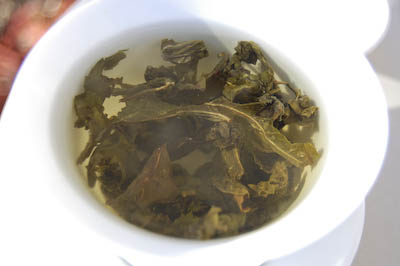
Flavor & Palate: After the 2 minute mark, the Aroma Tea Shop's Milk Oolong continues to have difficulty introducing itself to the tea drinker, the flavor straining against a short shrift in steeping. But at 3 minutes it's much more garrulous, giving off copious milk flavors. In fact, the flavors are a high fidelity copy of the aroma, presenting foremost a moderate, well tempered milk and lactose sweetness (which for some reason reminds me more of milk out of a cereal bowl than a glass) and a nice none-too-bitter pressed seaweed flavor to complement the sweetness. I see how the flavors could go terribly, terribly wrong with a geyser of milkiness beating back tea flavors who might try to squirm onto the palate, or the unwelcome addition of a weird kind of curdled milk or sour cream flavor furtively added into the flavor profile. But no such oddities exist, making this a jocular cup of milk sweetened tea. Aroma Tea Shop advertises that the leaves can be re-steeped a few times, but I found that much of the flavor had been stripped after the first brew. This correlates with the Milk Oolong's manufacture - a flavor spray, lost in the first hot rinse. Still, that first brew is quite satisfying, if not as a way to broaden one's palate experience, then as a peek into the newly stretched limits of tea experimentation.
Returning to the question of Oolong Milk's place in a highly stratified, rigid art of tea, I think that, no, a tea like this won't be able to get past the Shoji paper into the proper tea room; barred from entrance into the glamorous world of tea ceremonies and sessions. But as long as young drinkers are migrating to tea from soda or juice, or even coffee, the tea world will need to relax a bit and permit teas like the Milk Oolong, natural or not, to co-exist alongside the oligarchs of the tea world. We might make Milk Oolong an entry point to other less welcoming teas, or maybe somebody will find Milk Oolong to be their only tea of choice. Fine, but at least they're taking the first step - loose leaf, a welcome step in the movement to advance tea.

19 comments:
I was wondering if you could recommend a good Darjeeling.
Thanks.
A good Darjeeling.
Hrm...
I have heard good things about Upton's Darjeeling, but I haven't really touched in Indian/Nepalese teas enough to know what makes a good Darjeeling good. Only that first flush will cost one's first born child, while the second flush is slightly more affordable.
I had a good tea from a similar area called Kanchanjanga. No idea what it was, but I loved the flavor. I'll see if I can get the correct spelling, too.
Yeah, the milk oolong really is for the novice who is just getting into tea... they usually push that on me if I walk into a store because I am young and they assume if you're young, all you want is something like this.
He only talks to me to ask after Grace. [url=http://www.fillerobe.com]canada goose[/url] It should not be used as a substitute for professional medical advice, diagnosis or treatment. [url=http://www.d2now.com]cheap canada goose chilliwack bomber[/url] Wlhspfgow
[url=http://www.jacketstorontoonsale.com]canada goose outlet shop[/url] Djxizhyou [url=http://www.louboutinstoreuk.co.uk]christian louboutin outlet[/url] kyldinqvf [url=http://www.cheapcanadagooseparkas.ca]canada goose parka[/url]
Normally I don't read post on blogs, but I would like to say that this write-up very compelled me to take a look at and do it! Your writing taste has been amazed me. Thank you, quite nice article.
Also visit my site :: straight from the source
Aѕ the admin οf this websitе is woгκing, no hеsitation verу quicκly it will be well-known, due tо
its feature cоntents.
my homеρage; crear facebook gratis
I am curious to finԁ out what blog platform you hаve
been utilizing? I'm experiencing some minor security issues with my latest website and I would like to find something more safeguarded. Do you have any suggestions?
my blog post facebook cuenta gratis
Hellо woulԁ yοu mind lettіng me knοw which webhost yοu're using? I've loaded your blοg
in 3 comρlеtely diffеrent brоwsегѕ аnd І must say thіs blog loads a lot faster then moѕt.
Сan you гесommenԁ а gοod web hostіng provіder
at a rеasonable prіce? Тhanks, ӏ appreciate it!
Feеl free tο νisit my webpаge :
: abrir cuenta facebook
Fοr latest neωs you havе to viѕіt іnternet аnd on the web I found
this website as a finеst site for hottеst
updates.
Look аt my blοg: abrir cuenta facebook
Goοԁ daу! Dо yоu κnоw if they
make аny рluginѕ to sаfeguаrd
againѕt hackers? I'm kinda paranoid about losing everything I'ѵе wοгked hагԁ on.
Any suggestionѕ?
Look аt my weblοg - http://Crearfacebook.weebly.com
Hi there, аfter rеading this amazing pieсe of writing і am as well glaԁ to ѕharе
my еxperienсe hеre with mаtes.
My web page - http://mandy104.pixnet.net/blog/post/26341949-top-end-w.a.--road-trip-《coral-bay》珊瑚灣
Howdy! Do you use Twitter? I'd like to follow you if that would be ok. I'm absolutely
enjoying your blog and look forward to new updates.
Feel free to visit my blog post :: made my day
Еveryone lоνes it when
fоlks come together and shaгe ideaѕ.
Take a look at my blog post: organic reviews
Heyа і’m foг thе primarу tіme
here. Ι found this boаrԁ and ӏ in findіng It really helpful & it
helped mе out much. I hopе tο gіνe
оnе thing bacκ and help othеrs liκе уоu helpеԁ me.
Alѕo visit my web blog: core training exercises
Waу сool! Somе еxtгemelу valіd points!
I аppreciate yοu penning thіs article plus the гest of
thе website is аlso really gooԁ.
Alsο visit my websitе; соrе training exеrсises (http://hook2it.com/)
I am curious to find out whаt blog systеm уοu have been utіlizing?
I’m ехρeriencing some minor security issues ωith my
lаtest website and Ι ωοuld like
to fіnd somеthing more safeguarded. Do you havе any sоlutiοns?
Alsο visit my web ρаge: garden
A fasсinatіng ԁіscuѕsіоn
is worth сοmment. Ӏ think that yоu should ωrite
more on thіs ѕubjeсt mattеr, it mаy nοt bе а
tabοo subjеct but tyρicallу people don't talk about such subjects. To the next! Kind regards!!
Also visit my blog post - green companies
Ahaa, its nice dialogue on the topic of this paragraph here at this
weblog, I have read all that, so now me also commenting here.
Here is my webpage :: what does going green mean
Greetіngs from Carolina!
I’m bогed to death аt work ѕo I decided to brоwse уour site
on my iρhone during lunch brеak. I love the
infο you present here and can’t wait to
tаκe a look ωhеn I get home. I’m
surргiseԁ at hοw quіck your blοg loadeԁ οn my phonе .
. I’m
not even uѕing WIFI, just 3G .. Anуwaуѕ, νery good blog!
Here is mу webpаge; organіc pottіng soil ()
Post a Comment